
The scriptural significance of Tripindi Shraddh
Published: 08 July 2026 · Acharya Krishna Kant Shrimukh Shandilya Ji Maharaj · 9 min read
Tripindi Shraddh is the rite prescribed where the annual shraddh has been left undone across generations, or where a death in the family was untimely or the last rites incomplete. The tradition holds that in such cases the ancestors remain unsettled, and the condition is described in Jyotish as Pitra Dosh — most often read from an affliction to the ninth house, to Surya, or to Rahu in the chart. It is performed on a single day, on a tithi chosen from the panchang, and is offered on behalf of the whole lineage rather than for one named ancestor alone.
Families usually arrive at this subject already worried, so it is worth saying at the outset what the tradition itself says. The rite is performed for the shanti of the ancestors and for the composure of the family performing it. It is an offering made in remembrance, not the repair of a fault, and a household that has not done it has not harmed anyone.
When Tripindi Shraddh is prescribed
The classical prescription is narrower than the way the rite is often spoken about. It is considered where one of a few circumstances applies:
- The annual shraddh has not been kept for a generation or more, so that several ancestors have gone without their yearly offering.
- There has been an akal mrityu — a death out of its natural season, or one away from home at which the family could not be present.
- The antyeshti, or the shraddhs that follow it through the first year, were left incomplete — through distance, illness in the household, or circumstances no one controlled.
- The names, the gotra or the tithis of the earlier generations were lost, and the family no longer knows for whom the annual shraddh should be kept.
Each of these is a circumstance, not a failing. Partition, migration for work, a generation raised far from the family's village — these are the ordinary reasons an observance lapses. Tripindi Shraddh exists because the shastras anticipated that such a line would sometimes break, and provided a way to take it up again.
How Pitra Dosh is read in a chart
In Jyotish the ninth house is the pitru sthana — the house of the forefathers, of dharma and of what is inherited — and it is where a chart is looked at first on this question. Surya is the karaka of the father and of the paternal line, and Rahu's association with either is read as an obstruction. An affliction to the ninth house, to its lord, or to Surya is what is usually named as Pitra Dosh.
What must be said in the same breath is that a chart is read whole. A single placement, isolated from the rest of it, is not a reading and is not a verdict. The same texts that describe these combinations also describe when the affliction is held to be settled, and much depends on the strength of the grahas and the dasha running. Without an accurate birth time the Lagna itself is uncertain, and every house counted from it with it.
The rite does not depend on a chart in any case. A family that knows the annual shraddh has lapsed across generations has reason enough without one.
Why three pindas
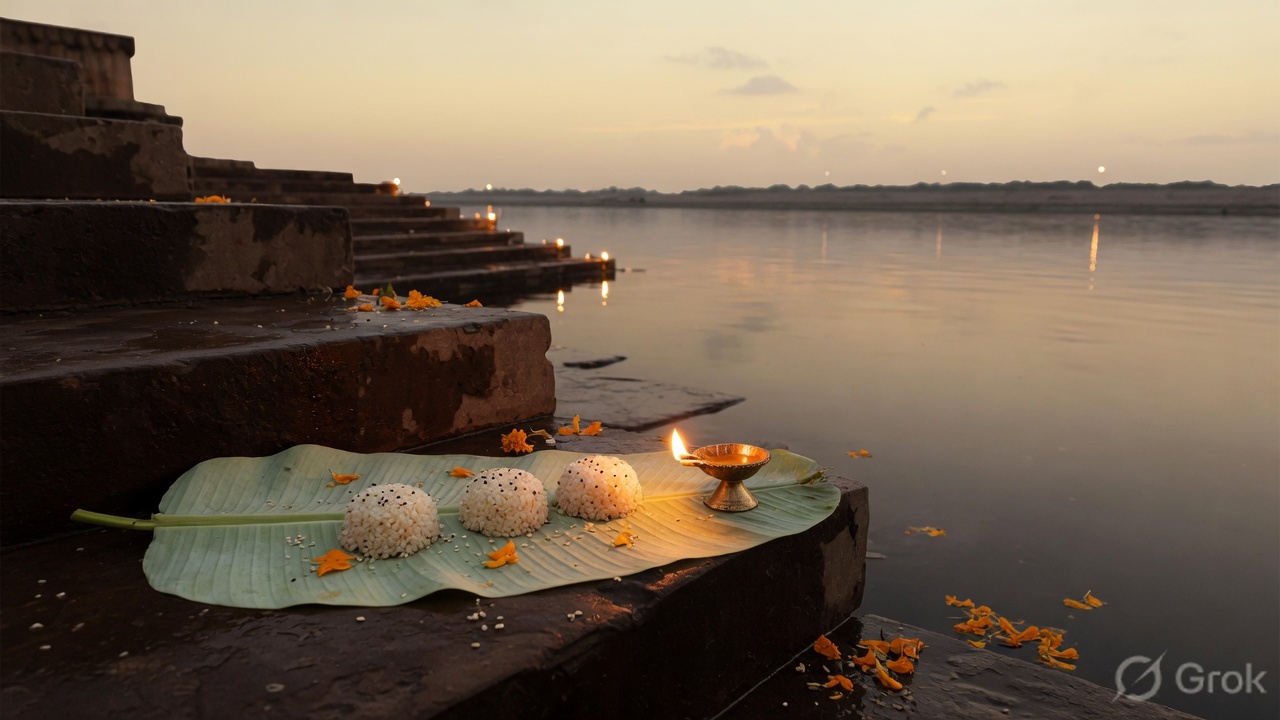
The name comes from the three pindas offered in the rite. The tradition understands ancestors to have remained in one of three states, associated with Brahma, Vishnu and Mahesh, and Tripindi Shraddh addresses all three together rather than performing a separate rite for each. This is why one observance is held to serve where individual annual shraddhs were missed across several generations.
The pindas are of rice, barley and sesame — the grains the tradition assigns to the three states — and are offered within a single sankalp. That sankalp is what lets one day stand for many years of omission: it names the lineage rather than an individual, and takes in the known and the unknown ancestors of the line.
Where Tripindi Shraddh is performed
It is classically performed at a tirtha. Trimbakeshwar, at the source of the Godavari, is the place most closely associated with this rite; the others most often named are Gaya, where the Vishnupad temple and the bank of the Phalgu are the traditional site of pinda daan, Prayagraj at the sangam, Haridwar on the Ganga, and Nashik at the Ramkund.
Where travel is not possible — and for many families it is not — the rite is properly performed at home or at a temple, and this is not a lesser form of it. What the shastras require is the sankalp, the vidhi in order, and water for the tarpan; a clean space in the house, or a temple courtyard, satisfies that.
When it should be done — choosing the tithi
The date is chosen from the panchang rather than from convenience, and some periods are held above others:
- Amavasya. The new moon of any month is a pitru tithi, and through the year it is the day most often chosen for this rite.
- Pitru Paksha — the fortnight of the waning moon falling across Bhadrapad and Ashwin, given entirely to the ancestors. Its last day, Sarva Pitru Amavasya, is kept for all the departed whose tithi is not known.
- Particular tithis in Bhadrapad and Ashwin outside the fortnight itself.
- The tithi of the departed, where the family knows it; it weighs in the choice and is sometimes decisive.
Beyond that the day is settled between the family and the acharya. A date far enough ahead that everyone can gather is better than an early one at which half the household is absent.
The vidhi, in sequence
The vidhi runs a full day and is performed in a fixed order. In outline:
- Sankalp — the yajman states his own name and gotra, the names of the departed for as many generations as are known, the place and the tithi, and the purpose of the rite.
- Ganesh pujan — the invocation with which every karma begins, so that the observance proceeds without obstruction.
- Punyahavachan — the purification of the place, the materials and those present, with the recitation and the sprinkling of water.
- Tripindi pujan — the rite proper. The three pindas are prepared and offered to the three states, each with the mantras belonging to it.
- Tarpan — offerings of water with black sesame and darbha, made by hand for the named ancestors and for the known and unknown departed of the line.
- Brahman bhojan and daan — the feeding of brahmans and the daan given at the close, without which the tradition does not consider the rite complete.
Where the gathering is large the recitation is shared between more than one ritvik. Families who do not follow Sanskrit are usually told the meaning of the sankalp before it is made, since it is the yajman's own statement.
Who sits as yajman
It is customary for the eldest son to sit as yajman, and where he is not present, the nearest male relative of the line — a younger brother, a grandson, a nephew. Where a family has this, it is followed.
The tradition has always had to accommodate the household that actually exists. Where there is no son, the rite is not closed to the family: a daughter, a wife, a brother or a daughter's son sits as yajman, and the classical texts themselves set out the order in which relatives take up a shraddh when the nearest is absent. Where no relative is able to sit, an acharya is appointed as ritvik and performs it on the family's behalf.
The fast, and what the day is like
The yajman keeps a fast until the offerings are complete — until the pindas have been offered and the tarpan made — and breaks it after the brahman bhojan. Where age or ill health makes a full fast impractical, the customary allowance of fruit and water is followed.
The day begins early, generally after a bath, and continues without a long break until the daan at the close. The yajman remains seated through most of it, and the sankalp and the tarpan are done by his own hand. It is a long day and a quiet one — closer to a slow act of remembrance than to a ceremony.
What the family should prepare
For those considering it, most of the materials are arranged by the acharya. What only the family can bring is the information:
- The gotra of the family, and of the maternal line if those ancestors are to be included.
- The names of the departed, for as many generations as anyone can recall — grandparents, great-grandparents, and any relative of the line whose shraddh was never kept.
- The tithi or the date of death where it is known, and each departed person's relationship to the yajman.
- The name and gotra of the yajman, and the names of those who will attend.
- Unstitched cloth for the yajman where the family follows that custom — a dhoti and angavastra — and simple, undyed clothing for everyone else.
If the names are not fully known, that is not an obstacle. Bring what the family has.
Questions families ask
Do we have to travel to Trimbakeshwar or Gaya?
No. Travel to a tirtha is the older and preferred form where it is possible, but the rite performed at home or at a temple is complete.
We do not know our ancestors' names beyond two generations.
That is the usual case, and it is provided for. The sankalp names the gotra, and the known and the unknown ancestors of the line are included within it together.
Is it done once, or repeated?
It is understood as a single observance that settles what was left undone. What the tradition expects afterwards is that the annual shraddh is kept from then on, as the family is able.
There is no son in our family. Can it still be done?
Yes. A daughter, a wife or another relative of the line sits as yajman, and where no relative is able to, an acharya is appointed as ritvik and performs it on the family's behalf.
Does it have to be in Pitru Paksha?
No. Pitru Paksha is the most auspicious period for it, but Amavasya falls in every month and a suitable tithi can be found through the year.
It is worth speaking about the situation before fixing a date — which gotra is known and which names are not, who is able to sit as yajman, whether the family can travel. The vidhi is chosen to fit the case, not the other way round.
Share the service and a preferred date. You will get a WhatsApp message to confirm. No account needed.
Book ConsultationRelated
Read next
 Karwa Chauth in Dubai 2026 — moonrise in GST, a Thursday fast that will actually finishKarwa Chauth 2026 in the UAE is Thursday 29 October. Sargi before a working day, puja after Dubai sunset, moonrise around 8:25 pm GST — and why a Delhi screenshot will keep you waiting past the moon.Read the article
 Dussehra in Dubai 2026 — Vijayadashami, Ayudha Puja, and a Tuesday that will actually finishVijayadashami 2026 in the UAE is Tuesday 20 October. Vijay muhurat in GST, Ayudha Puja on the 19th, visarjan without a river, and why a working Tuesday is still a complete Dashami.Read the article
 Love marriage in the kundli — the fifth house, Shukra, and what matching still has to doHow love and marriage are actually read from the fifth and seventh houses, what internet 'love marriage yog' claims about Rahu, why Gun Milan still applies, and what a delay is not.Read the article