
Shrimad Bhagwat Katha in Dubai — how a Gulf household actually holds it
Published: 18 September 2026 · Acharya Krishna Kant Shrimukh Shandilya Ji Maharaj · 8 min read
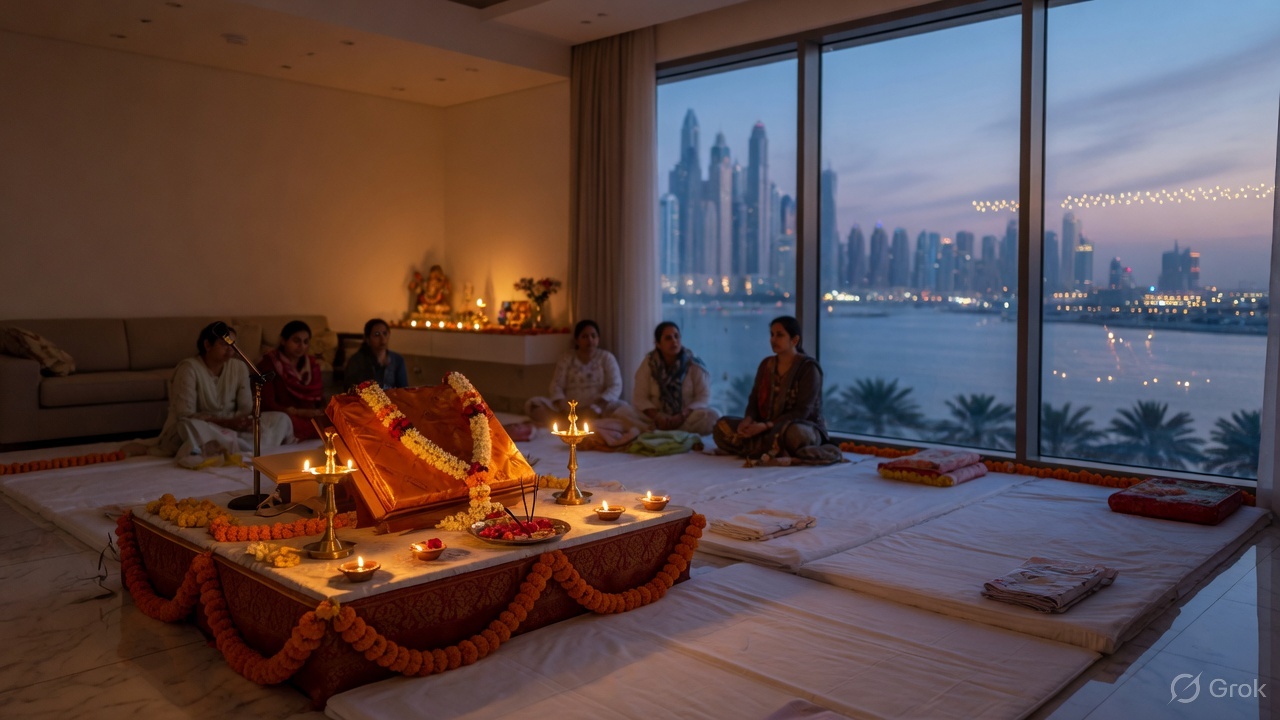
A Shrimad Bhagwat Katha in Dubai is the same recitation as one in a courtyard in Sultanpur: the Bhagwat Puran spoken from a Vyas Peeth, a sankalp on the first morning, prasad at the close of each sitting. What changes is the room, the weekend, the neighbours, and the sky the tithi is counted under. Families write from Jumeirah, International City, Sharjah and Abu Dhabi asking whether a Katha 'counts' in a flat, whether the vachak must fly, and whether a Friday–Sunday sitting can stand in for seven weekdays no one can take off. The Puran does not name a city. It names a hearing.
I write this as a vachak based in Sultanpur who is asked this every season, usually in English first and then in Hindi once the family is sure they will not be told that only India will do. This is not a second, lesser Katha. It is the same niyam in a different house. A separate article on this site covers the seven-day shape, the Vyas Peeth and the bhandara as they are prepared in India. What follows is what changes when the house is in the UAE.
Seven days, three days, or one — what actually fits a Dubai week
The Saptah is still the full form: seven sittings, three to four hours each, first skandha to the twelfth, havan and bhandara on the last day. In the Gulf it is the hardest to keep, because leave is scarce and a villa that will hold eighty people for a week is not the common case. A three-day Katha carries the same arc compressed — opening and creation, the bhakt charitras, then the tenth skandha — and is the form most Dubai households actually complete. A one-day Katha is usually the dashm skandha, and is the honest choice for a birthday, a naming, a griha pravesh, or a vow that should not be stretched across a week the family cannot sit.
Friday and Saturday are the weekend for most of the UAE. A three-day Katha that begins Friday evening, sits Saturday, and closes Sunday afternoon is the pattern that fills a room. A Saptah that asks people to arrive at ten on a working Wednesday will be a Katha the host sits alone. It is better to hold the form the family will attend than to hold the longer form as a performance of piety.
The room: villa, hall, apartment
A villa with a majlis or a covered courtyard is the easiest: the Peeth faces east or north, shoes at the door, a sheet on the floor, the kitchen already built for a bhandara. A community hall in Karama, Bur Dubai or a society clubhouse is the next: book it for the hours you will actually sit, not for a round-the-clock occupation the building will not allow. An apartment is enough for a one-day or a small three-day Katha if the Peeth can be raised a foot and a half, the pothi kept off the floor, and the neighbours told in advance that there will be singing in the evening, not at midnight.
Dubai buildings have rules that a village courtyard does not. Volume after ten, parking, the fire exit, a cooking restriction in some towers — these are not insults to the Katha. They are the conditions under which the Katha will be allowed to finish. Ask the building before you ask the panchang. A tithi that looks perfect on paper and gets the sitting stopped at 9:30 is a worse tithi than the next one the hall will honour.
Time: GST, IST, and the tithi you are actually under
Gulf Standard Time is one and a half hours behind India. A sankalp named in IST while the family is sitting in Dubai names the wrong hour of the wrong sky. The tithi is local. If the sitting is in Dubai, the panchang is Dubai's, not Sultanpur's, and a vachak who is still in India on a video link must be told which clock the room is using. Evening GST is late evening IST: a 7:30 pm start in Dubai is 9:00 pm in Uttar Pradesh, which is why a live sitting across the two clocks is shorter and earlier than a sitting in one room.
WhatsApp is how the booking is made, in English or Hindi, with the city named — Dubai, Sharjah, Abu Dhabi — so the tithi and the travel, if any, are not guessed. There is no online payment on this site. Dakshina, samagri and any travel are spoken before the date is fixed, the same as for a Katha in Lucknow.
Does the vachak have to fly?
Three honest forms, none of them a compromise dressed as a rule.
- The family sits in Dubai with a vachak who can travel. That needs dates, a visa, and a hall or villa already held. It is arranged where the calendar allows, not promised as a package on a page.
- The family comes to India for a Saptah in the home district, which is still the easiest place to keep seven full days, a bhandara and the elders who will not board a flight.
- The family sits in Dubai for a one-day or three-day Katha, and a consultation, a sankalp and a shorter recitation are held over a live link when travel is not possible. The Peeth is still in the room. The hearing is still in the room. What is not in the room is the excuse that nothing was done because a ticket was expensive.
A flight is not a sacrament. Presence is. A room that sat through the tenth skandha on a Friday in Dubai has kept more of the book than a ticket purchased and a week no one attended.
The Vyas Peeth in a flat
The seat is still treated as Vyas's, not as furniture. Raised, east or north, a clean cloth, the pothi on its own stand, a kalash that stays for the duration. In a Dubai apartment the platform is often a low table dressed for the week, and that is enough. Do not put the book on the dining table between meals. Do not face the Peeth into a television that stays on. Tell the children the room has one job until the last aarti.
Samagri that is ordinary in Sultanpur is a shopping list in Dubai: mango leaves, a particular mitti, a specific samidha. Substitute what the city actually sells — clean water, a coconut, a lamp, flowers the market has, ghee that is ghee — and say so in the sankalp rather than flying a suitcase of leaves that will not last the week. The sankalp names the place as Dubai, the UAE, the year and the tithi. It does not need to pretend the room is in Ayodhya.
Language in the room
A Dubai Katha is rarely one language. Gujarati families, Hindi-speaking households from UP and Bihar, Malayalam and Tamil neighbours, children who answer in English — the vachak who cannot move between Hindi and English will lose the back row. I keep both. The Puran is not smaller in English. It is heard. Ask when you book which language the elders need, and which the children will actually follow. A sitting that is only in a language half the room does not have is a sitting they will remember as long.
Dates that fight the fortnight
Pitru Paksha 2026 runs 26 September to 10 October. A celebratory Katha — a birthday, a new house, a thanksgiving — is set outside that fortnight. A Katha deliberately held for someone who has died may be set inside it; that is a different sankalp, and should be named as one. Navratri follows on 11 October. Diwali in 2026 falls on Sunday 8 November. The weekends that fill a Dubai hall in late October and November fill early. Bring two or three windows, not one Friday that everyone else already took.
What to send on WhatsApp so the date can be discussed
- The city and the kind of room: villa, hall, apartment.
- How many days you can actually sit, not how many you wish you could.
- Friday–Sunday or another window, in GST.
- The purpose of the sankalp, in a sentence.
- Whether travel to the UAE is being asked, or a sitting in India, or a live link.
- How many people you expect on the fullest day — Janmotsav and Rukmini vivah if it is a Saptah — because prasad and the hall follow from that number, not from hope.
Questions families in the UAE ask
Does a Katha in a Dubai flat count?
Yes. The Puran is heard where it is recited with a sankalp. A city does not have to be named in the text for the hearing to be valid.
Can we do seven days in an apartment?
You can. Most families cannot, because of leave, neighbours and space. Three days or one is not a lesser Katha. It is the niyam the house can keep.
Must we wait until the vachak can fly?
No. Travel is one form. A sitting in India is another. A live sitting with the Peeth in your room is a third. Waiting a year for a visa while doing nothing is the one form the book does not describe.
Which language will it be in?
Hindi and English, as the room needs. Say which elders require which, when you write.
Can we hold it during Pitru Paksha?
A Katha for the dead may be. A celebratory one is better outside 26 September–10 October 2026. Ask, rather than assuming the fortnight is closed to all recitation.
Is there a temple in Dubai that replaces the home Katha?
Temples in the UAE hold their own recitations, and a family may join them. A home Katha is a different niyam: the sankalp is yours, the Peeth is in your house, the bhandara is your guests. One does not cancel the other.
Share the service and a preferred date. You will get a WhatsApp message to confirm. No account needed.
Book ConsultationRelated
Read next
 Karwa Chauth in Dubai 2026 — moonrise in GST, a Thursday fast that will actually finishKarwa Chauth 2026 in the UAE is Thursday 29 October. Sargi before a working day, puja after Dubai sunset, moonrise around 8:25 pm GST — and why a Delhi screenshot will keep you waiting past the moon.Read the article
 Dussehra in Dubai 2026 — Vijayadashami, Ayudha Puja, and a Tuesday that will actually finishVijayadashami 2026 in the UAE is Tuesday 20 October. Vijay muhurat in GST, Ayudha Puja on the 19th, visarjan without a river, and why a working Tuesday is still a complete Dashami.Read the article
 Love marriage in the kundli — the fifth house, Shukra, and what matching still has to doHow love and marriage are actually read from the fifth and seventh houses, what internet 'love marriage yog' claims about Rahu, why Gun Milan still applies, and what a delay is not.Read the article