
Jyotish consultation
Vastu Consultation for Home, Plot and Shop
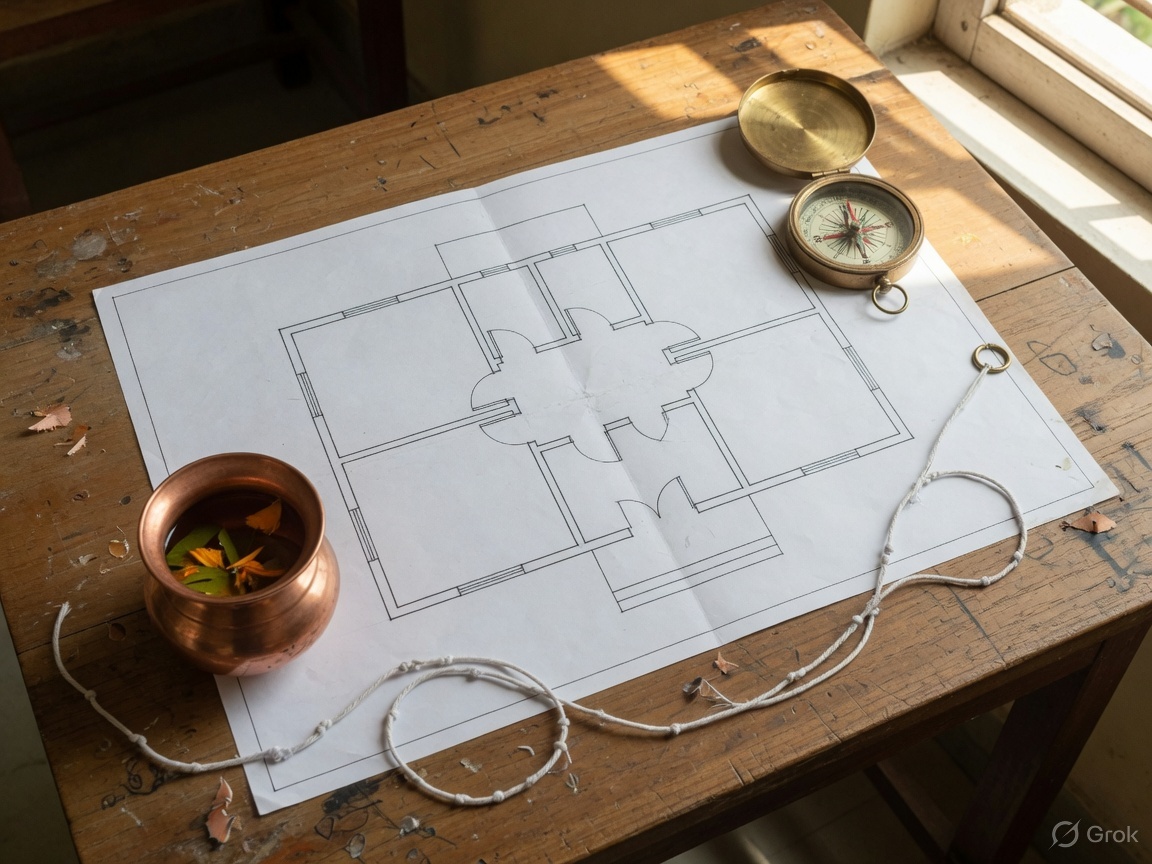
Vastu review of a home, plot or shop — from a floor plan on WhatsApp or a site visit — with corrections before any demolition.
Vastu consultation for a home, plot or shop: a floor-plan review on WhatsApp or video, or a site visit near Sultanpur, with corrections before demolition.
What this includes
- Floor-plan review with north marked
- Entrance, kitchen, puja room and bedroom placement
- Brahmasthan, water, slope and toilets
- Corrections without demolition, in order of priority
- Site visit where the plan cannot answer
- Vastu Shanti Puja where it is warranted
Families usually come to Vastu after hearing one of two things. Either a relative has said the house faces south and must therefore be unlucky, or a website has listed forty rules and the house breaks thirty of them. Some have already been told to break a wall, move a staircase or sell a plot. Vastu Shastra is not a list of forty rules, and it is not a verdict on a door. It is a way of placing the uses of a building — fire, water, worship, rest, storage, entry — in relation to the directions and to the open centre. Read as a whole, most houses need a few changes of use, not a hammer.
I give Vastu consultations for homes, plots and shops. Most begin with a floor plan sent on WhatsApp. Some need me on the site. Where a house is new, or has been rebuilt, a Vastu Shanti Puja may be held. This page explains each of these, and what each can and cannot be asked to do.
The directions and the centre
The Vastu Purush Mandal lays the eight directions and the centre on a grid. Each direction has its devata and its use.
- Ishan (north-east) — water and worship. Kept light, open and clean.
- Purva (east) — Surya and Indra. Morning light, windows, often the entrance.
- Agneya (south-east) — Agni. The kitchen and the electrical load.
- Dakshin (south) — Yama. Not a direction to fear; a place for solid walls and weight.
- Nairitya (south-west) — stability. The master bedroom, heavy storage, the overhead tank.
- Paschim (west) — Varuna. Dining, study, children’s rooms.
- Vayavya (north-west) — Vayu. Guests, storage, things that move.
- Uttar (north) — Kuber. Open space, the cash box, a working desk.
The Brahmasthan is the centre of the plot or of the house. The tradition keeps it open: no toilet, no staircase landing on it, no heavy column where it can be avoided, no clutter. In the old courtyard houses of Awadh the centre was the aangan, open to the sky. In a flat it is usually a passage or the living room. The only request is that it not be blocked.
The entrance is read by its position, not only its facing
The most common fear I hear is a south-facing door. The tradition does not say a south door is bad. It divides each side of the mandal into padas, and the door is read by the pada it falls on. A south-facing door in the right portion of the wall is accepted. An east-facing door at the wrong corner is not good merely for being east. This is why I ask for a plan with measurements, not only the facing.
I also look at what the door opens onto. A door that opens straight onto a staircase, a toilet door, or a blank wall one step away is a more practical problem than the compass reading.
Kitchen, puja room and bedroom
Kitchen in Agneya
Agni belongs to the south-east. The kitchen goes there first, and the stove is set so that the one cooking faces east. Where the south-east is not available, Vayavya is the accepted alternative. A kitchen in the north-east, on the water side, is the placement I am asked about most. It is usually corrected by moving the stove, not the kitchen.
Puja room in Ishan
Ishan is the corner of water and worship. The puja room, or a puja shelf, goes there, placed so that the one who prays faces east or north. It should not share a wall with a toilet, and nothing heavy should be stored above it. In a small flat, a clean shelf in the north-east of the living room is a full answer. A separate room is not required.
Bedroom in Nairitya
The south-west is the place of weight and stability, so the master bedroom goes there. The customary advice is to sleep with the head towards the south or the east. Children’s rooms sit well in the west. A guest room in the north-west follows the same logic: Vayu moves, and guests leave.
Water, slope and the plot
For a plot or an independent house, I look at slope and water before rooms. The tradition wants the land higher in the south-west and lower in the north-east, so that rainwater leaves towards the north or east. An underground tank or a boring goes in the north-east, the north or the east. An overhead tank is heavy, so it goes in the south-west or the west. Toilets and septic tanks keep away from Ishan and from the Brahmasthan. A plot that slopes the wrong way can often be corrected while it is levelled, before the foundation. It cannot be corrected by a puja.
A plan review, or a site visit
Most consultations begin with a plan. Send these on WhatsApp:
- A floor plan of every storey, with measurements.
- North marked from a compass reading taken inside the house, away from steel and appliances — not guessed from the road.
- Photographs of the entrance from outside, the kitchen, the puja place and each bedroom.
- For a plot: its shape, measurements, the roads on each side, and the slope as you see it after rain.
- For a shop: where the counter, the cash, the stock and the owner’s seat are.
We then go through the plan on a video or WhatsApp call, room by room. A site visit is better where the plan cannot answer: before buying a plot, when deciding where to dig a boring, for an irregular building, or for a shop whose surroundings matter. In Sultanpur and the nearby districts — Ayodhya, Amethi, Pratapgarh, Jaunpur — a visit is easily arranged. Elsewhere in India it is a matter of travel, discussed on WhatsApp. For a house outside India, the plan review is done online.
Corrections before demolition
I give corrections in order, the least disruptive first. Breaking a wall is the last answer, not the first.
- Change of use — the store becomes a bedroom, the bedroom becomes a study.
- Movement within a room — the stove, the bed, the puja shelf, the cash box, the desk.
- Clearing — the Brahmasthan and the north-east emptied of weight and clutter.
- Light and water — the north-east kept bright; leaks and blocked drains repaired.
- Small construction — a door re-hung, a tank shifted, a partition, if the family chooses it.
- Structural change — only when the family is rebuilding anyway, and only with their own engineer.
I do not sell crystals, pyramids, mirrors or vastu kits. If a correction needs an object, it is an ordinary one the family already owns or can buy anywhere. In a rented home, corrections stay with use and placement, and those are usually enough.
Vastu Shanti Puja, where it is warranted
A Vastu Shanti is not needed for every house. It is customary before Griha Pravesh into a new house, after a major reconstruction, or when a house that stood empty for long is lived in again. It is held at the house itself, with the family present. Bhoomi Pujan, before a foundation is dug, is a separate rite on the plot.
- Ganesh puja, and the sankalp in the name and gotra of the head of the household.
- Kalash sthapana and punyahavachan.
- The Vastu mandal drawn, and the avahan of Vastu Purush and the devatas of the padas.
- Navgraha puja.
- Havan with the Vastu mantras, including those addressed to Vastoshpati in the Rigveda.
- Purnahuti, aarti, and the shanti jal of the kalash sprinkled through the rooms.
- Brahman bhojan and dan, as the family’s means allow.
The samagri list is shared on WhatsApp once the date is fixed. The family arranges the samagri and the space. I bring the vidhi, the mantras and the order of the day.
Muhurat
The date of a Vastu Shanti or a Griha Pravesh comes from the Panchang, not from a convenient Sunday alone. Kharmas, when the Sun is in Dhanu or Meen, is customarily avoided, and many families avoid Chaturmas as well. Rikta tithis and Amavasya are left out. Nakshatras such as Rohini, Mrigashira, Uttara Phalguni, Uttarashadha, Uttara Bhadrapada and Revati are among those the tradition prefers for entering a house. The chart of the head of the household is checked too. I do not publish a list of dates. The right date is the one that fits your Panchang and your family.
What Vastu cannot promise
Vastu describes how a building is placed. It does not promise profit in a shop, the sale of a plot, recovery from an illness, or peace in a marriage. If someone in the house is unwell, the doctor comes first; a Vastu correction is made alongside medical care, never instead of it. A shop’s accounts depend on its trade. I say this at the start of every consultation, so that no one moves a stove expecting a miracle.
A house is read whole, like a chart. One wrong corner is not a verdict on the family that lives in it.
What a consultation needs from you
The plan, the north and the photographs are listed above. With them, send your question in one sentence: are you buying, building, renovating, or living in a house you cannot change? Say whether the house is owned or rented. If someone has already looked at the Vastu and told you something, send that too, so we begin from it rather than argue with it in the dark.
Questions people ask
- Can a Vastu consultation be done online?
- Yes, for most flats and houses. Send a floor plan with measurements, north marked from a compass reading taken inside the house, and photographs of the entrance, kitchen, puja place and bedrooms on WhatsApp. We then go through it room by room on a video call. Buying a plot, siting a boring, or an irregular building is better seen on site. A Vastu Shanti Puja itself is held at the house, not online.
- Is a south-facing house bad according to Vastu?
- Not by its facing alone. The tradition reads the main door by the pada it falls on along the wall, not only by the direction it faces. A south-facing door in the right portion of the wall is accepted; an east-facing door at the wrong corner is not good merely for being east. The kitchen, Ishan, the Brahmasthan and the slope matter as much as the door.
- Can Vastu dosh be corrected without demolition?
- In most homes, yes. I give corrections in order: a change in the use of rooms, then moving the stove, bed, puja shelf or cash box, then clearing the Brahmasthan and the north-east, then light and water. Structural change comes last, only when the family is rebuilding anyway and with their own engineer. I do not prescribe crystals, pyramids or kits.
- When is a Vastu Shanti Puja needed?
- It is customary before Griha Pravesh into a new house, after a major reconstruction, or when a house that stood empty for a long time is lived in again. It is not needed for every house, and it does not replace the corrections a plan review finds. The date is taken from the Panchang, avoiding Kharmas, Rikta tithis and Amavasya, with the head of the household’s chart in view.
- Will Vastu improve my business or my health?
- Vastu describes how a building is placed. It does not promise profit, a sale, a cure or harmony at home. A shop’s accounts depend on its trade. Illness needs a doctor, and any correction is made alongside medical care, never instead of it. What a careful review gives is a house whose uses are in order, which families often find easier to live and work in.
- Duration
- 1–2 hours per review
- Where it is held
- Plan review online, or a site visit
- Phone
- +91 94547 82346
Vastu Consultation for Home, Plot and Shop
Book this serviceServices
Jyotish consultation
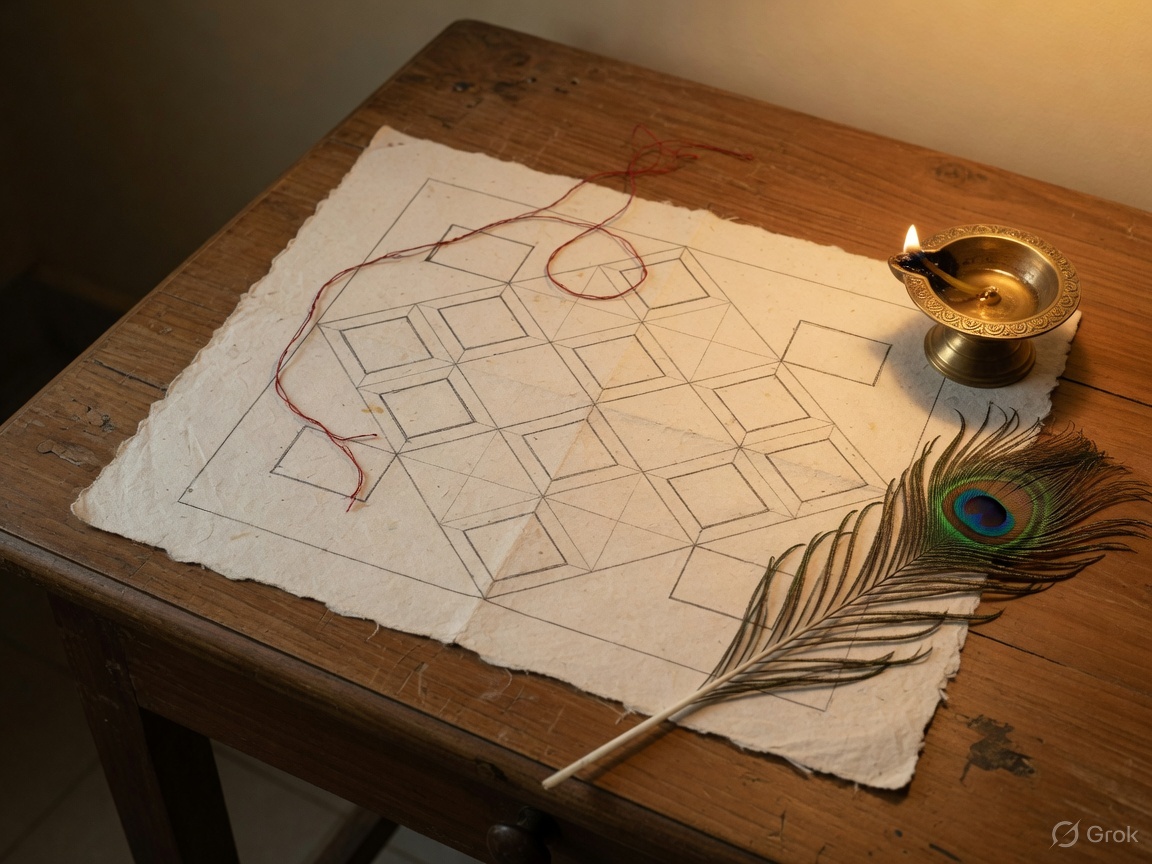
Janam Kundli Reading and Astrology Consultation
Your janam kundli prepared from birth details and read whole — lagna, grahas, dasha and gochar — without fear.
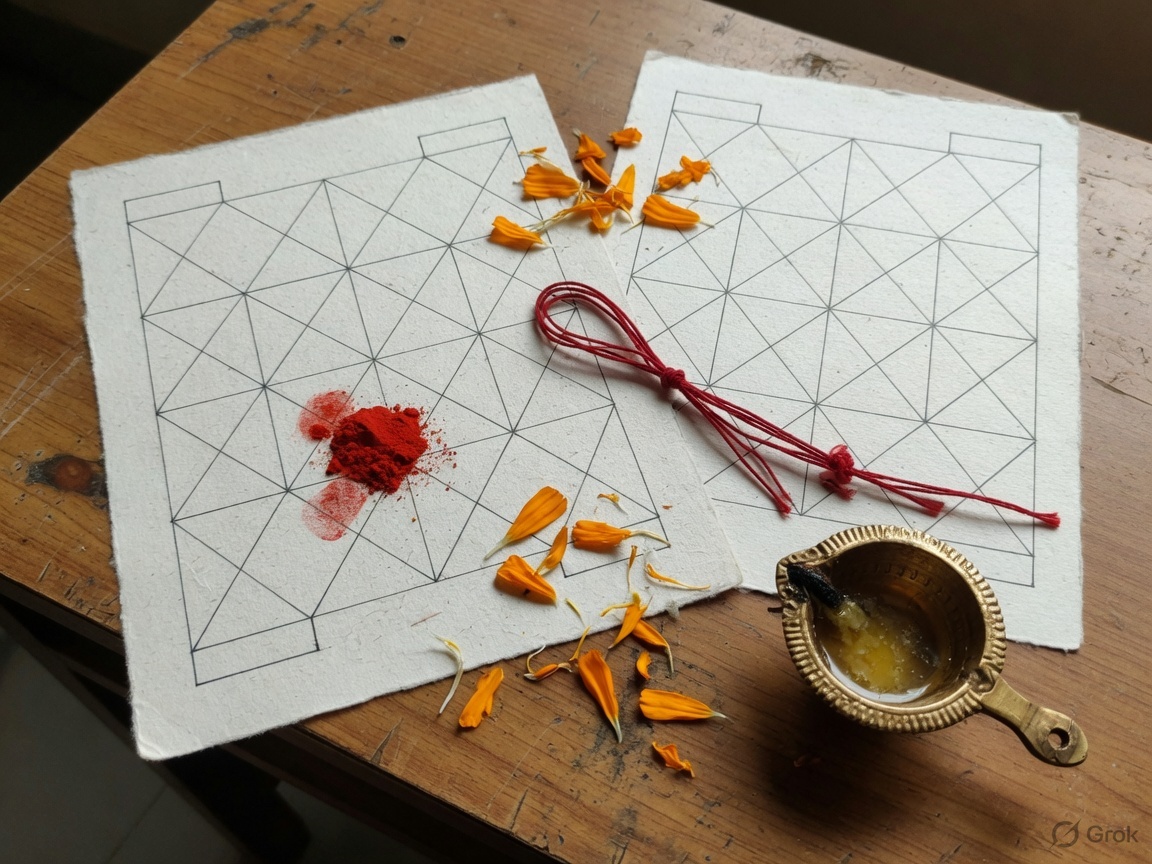
Kundli Milan (Gun Milan) for Marriage
Ashtakoot gun milan for marriage, with Nadi, Bhakoot and Mangal read alongside — and both charts read whole.
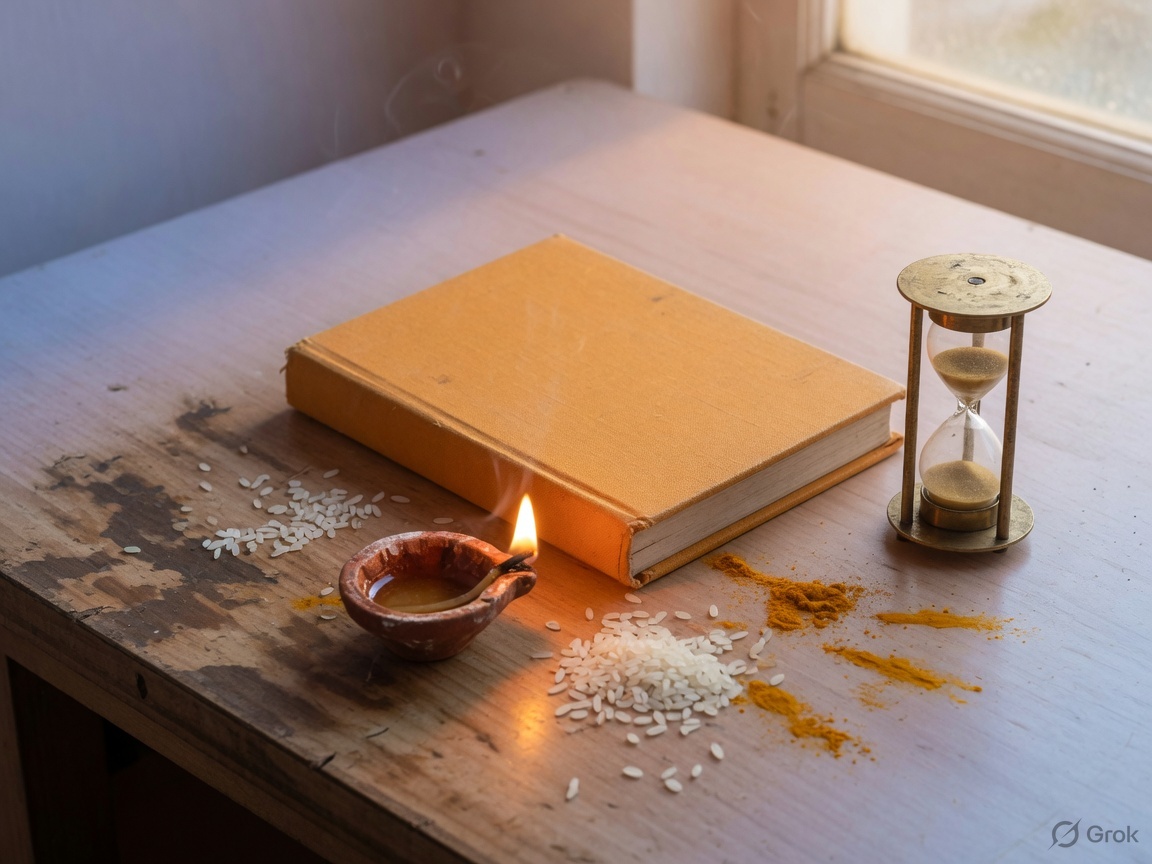
Shubh Muhurat for Vivah, Griha Pravesh and More
A shubh muhurat for vivah, griha pravesh, mundan, namkaran or a new venture — chosen from the panchang and your own chart.