
Ahoi Ashtami in India 2026 — Sunday 1 November, stars and not the moon
Published: 21 October 2026 · Acharya Krishna Kant Shrimukh Shandilya Ji Maharaj · 10 min read
Ahoi Ashtami in a North Indian house is the Ashtami of the dark fortnight of Kartik, kept by a mother for the children of that house. People arrive at it already told three things. The fast must run until the moon or the children are not 'covered'. A printed picture from a shop is less than a drawing on the wall. And a woman who eats, because she is pregnant or unwell, has broken something that cannot be repaired. None of those three is the vrat I sit with in Sultanpur. The day is an evening. The release is the stars. The drawing is a help to the eye, not a test of art. And a body that must eat, eats.
I am writing this on 21 October 2026, from Sultanpur. On the working panchang I use, Ahoi Ashtami is Sunday 1 November 2026. Karwa Chauth, the Chaturthi of the same dark fortnight, is Thursday 29 October. Dhanteras is Friday 6 November. Lakshmi Puja on the Amavasya is Sunday 8 November. Govardhan is Monday 10 November, Bhai Dooj Tuesday 11 November. Ahoi sits in the quiet week between the Karwa moon and the Diwali lamp. It is not a smaller Diwali, and it is not Karwa kept again for sons. It has its own evening.
Why the vrat is the 1st, when sunrise is still Saptami
This is the argument that splits families every few years, and 2026 is one of those years. On the working Delhi sheet, Krishna Ashtami does not begin until the afternoon of Sunday 1 November — about 2:52 p.m. IST — and it runs through to about 1:11 p.m. IST on Monday the 2nd. At sunrise on the 1st the tithi is still Saptami. A rule that names the day by the tithi at sunrise will therefore call Monday the Ashtami. Houses that follow only that rule will move the vrat, and they are not inventing a day. They are using a different clock.
The Ahoi that most of the houses I know actually keep is not named by sunrise. The worship is in the evening, when the stars come out, and on 1 November that evening already sits inside Ashtami. The fast, the drawing, the water through the sieve and the meal afterwards belong to that evening. I keep the vrat on Sunday 1 November 2026 for that reason, and I say the reason aloud so that a mother-in-law in another district, reading a sunrise table, is not accused of having 'got the date wrong'. Two honest clocks exist. A house picks one before the week begins and does not change it at 4 p.m. because a second website looked stricter.
A sheet for the fridge, in Indian time
These are working figures for the Delhi sky, which is close enough to Sultanpur, Jaunpur, Lucknow and the districts around them that the evening is the same evening. Confirm your city on the morning of the 1st. Do not treat a minute I print in October as a muhurat carved in stone.
- Sunday 1 November 2026 — Ahoi Ashtami, the evening I am using.
- Ashtami on the working sheet — from about 2:52 p.m. IST on the 1st until about 1:11 p.m. IST on the 2nd.
- The fast — from sunrise, or from the hour your own house has always begun it. Many mothers in these districts take nothing from the morning meal onward.
- Sunset — late afternoon, a little before six in early November on the plains. The lamp is lit as the house darkens, not at noon because a reel said the earlier the better.
- Tara-darshan — the first stars you can actually see, often spoken of near six in the evening in Delhi on the working figures. It is a sighting, not a printed minute. Cloud, a lane of tall houses, a tube-light in the neighbour's courtyard, all of these move the moment.
- Moonrise — late, near half past eleven at night on the Delhi working figure. That moon belongs to a named exception, not to the ordinary close of this vrat.
If your city is Mumbai, Chennai, Kolkata or a hill town, the sun and the stars are not Delhi's. Open a panchang set to that city. The date of the vrat does not change because you crossed a state. The minute of the star does.
The stars, and the moon that arrives too late to be the point
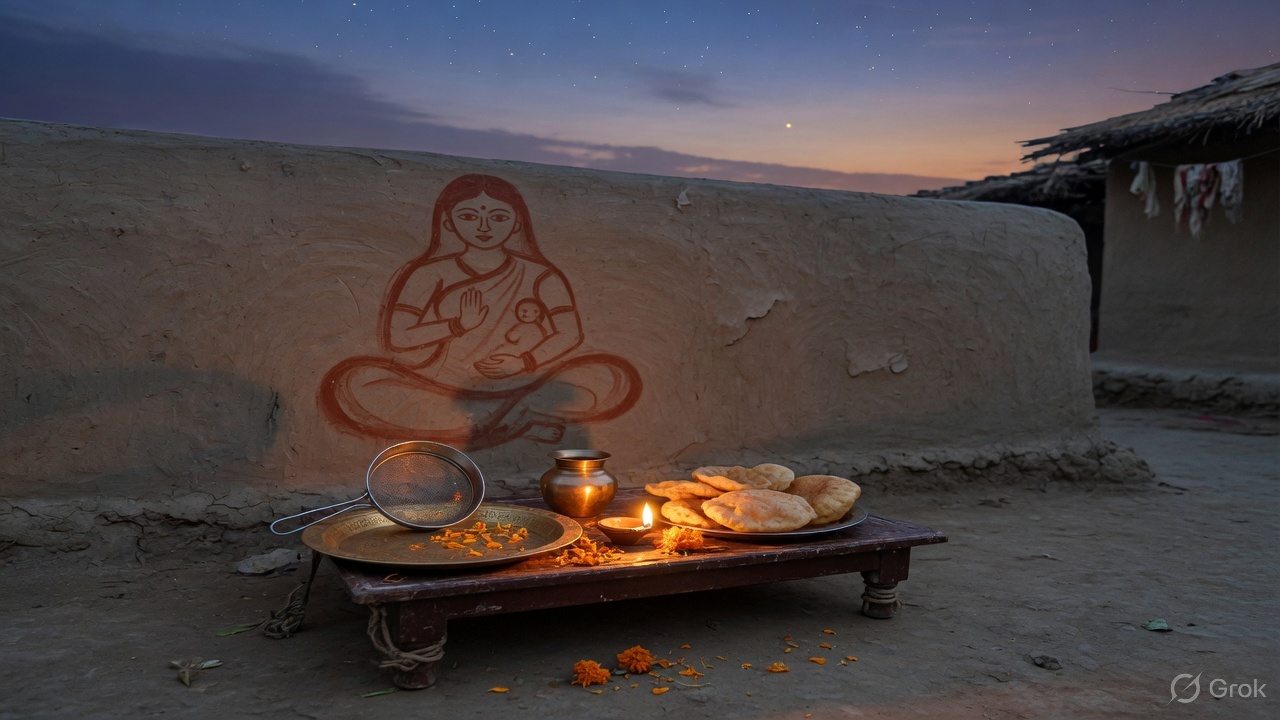
Karwa Chauth, eight days earlier, waits for the moon. Ahoi does not, in the houses that taught me the day. The mother looks for the stars. She takes water in a vessel, often through a sieve — the chalni of the kitchen — and offers it toward that sky, then the fast is over and the house eats. The sieve is not a decoration. It is how the water is given, a scatter rather than a pour, the way the older women of the lane still do it.
A few families, especially those who keep the Radha Kund custom, wait for the moon instead. On this year's working sheet that moon is close to 11:30 at night in Delhi. If that is your house, keep it, and eat late, and do not let a neighbour shame you for it. If it is not your house, do not add six hours to the fast because a video titled the vrat with the moon. Decide in the morning which sky you belong to. Switching at dusk is how a mother faints and a family argues.
The wall, the picture, and what is actually offered
The older form in these districts is a drawing on a clean patch of wall: Ahoi Mata, and with her the syahu and the young ones the katha remembers. Geru, roli, a finger, a quiet hand. A printed image is what a rented room and a landlord's paint now often require. I do not rank them. The eye needs a place to rest while the water is offered. A drawing made with care and a picture kept clean are the same help. A photograph of a film actress with a diya in front of it is not.
What is offered is ordinary food the house can cook: puri, a halwa or a kheer, fruit, water. The point is that it is set down before the image before anyone eats it. I have watched families spend the afternoon on a sweet ordered from a market and forget the water and the sieve. The market sweet can sit on the thali. It cannot replace the sky.
The katha, told as a katha
The story the lanes tell is a mother's grief. Versions differ, and I will not pretend they are one text with one author. In the telling I grew up with, a woman loses a child to the wild, keeps this evening's fast, offers water to the stars through the sieve, and the telling ends with the child restored. Other houses tell it with more than one child, or with the syahu as the creature of the forest. The details move. The shape does not: a loss, a vrat, an evening sky.
I tell that story when a house asks for it, and then I say what the story is not. It is not a contract. A child who is ill is not returned because a sieve was lifted. A womb is not filled because a wall was drawn. A boy is not ranked above a girl because an older verse said 'sons'. The vrat, as I keep it with families now, is for the children of the house — daughters and sons — and it is a niyam of care kept once a year. Anyone who sells it as protection from accident, illness or death is selling fear. I will not.
Who should eat
A pregnant woman eats. A woman who is ill eats. A woman whose physician has told her not to fast eats. A girl keeping the day for the first time, dizzy by afternoon, eats. The vrat is a discipline of attention for a body that can hold it until the stars. It is not a competition with the neighbour, and it is not proof of love. A mother who drank water and was present at the sieve has kept more of Ahoi than a mother who was carried in from the courtyard.
Children do not fast to prove the mother's vrat. They may sit, they may watch the drawing, they may eat when the stars have been seen. The older custom of the mother serving them first, after she has offered the water, is the one I still like. The day is hers. The meal is the house's.
Sunday in a district that is actually off
In most of North India Sunday 1 November is a weekly holiday. Schools are shut. Many offices are shut. That is a mercy this year, and it should be used for the evening, not for a market that eats the afternoon. Sweep the patch of wall in the morning. Decide the food before noon. Fill the water. Find the sieve, which will otherwise be in the washing-up at the exact minute the first star shows. Tell the lane if you will be in the courtyard, so that a tube-light is not switched on in your face.
If your work does not stop on Sunday — a hospital, a shop, a train — keep the morning small and the evening protected. The stars will not move because a shift ran long. Come home to a thali that is already laid.
What I will do, and what I will not
Ahoi does not need a pandit in the room. A mother who knows the evening can keep it. If a house wants the katha read aloud with them, or wants the date confirmed against their own city because a wedding or a journey is sitting on the same Sunday, that conversation is on WhatsApp, in Hindi, with the district named. There is no online payment on this site. Dakshina, if a sitting is arranged, is spoken before the day. I am based in Sultanpur. I travel when a date is fixed. I sit in India when the family comes. A live link is the third form, when the wall is in another city and the voice can still be in the room.
I will not promise a child. I will not name a price on a page. I will not tell you that a particular sweet, a particular number of rounds, or a particular shop-picture is what makes the vrat 'work'. The evening works when the stars are seen, the water is offered, and the house eats without turning a mother's love into a threat.
Questions people ask
Is Ahoi Ashtami on 1 or 2 November 2026?
I keep it on Sunday 1 November, because Ashtami is already running by the afternoon and the stars of that evening fall inside it. A sunrise table can call Monday the Ashtami. Pick one rule with your elders before the day, and stay with it.
Do we wait for the moon?
Not in the ordinary North Indian house. The fast breaks at tara-darshan, the evening stars, with water offered through a sieve. The Radha Kund custom waits for a moon that is near 11:30 p.m. in Delhi this year. That is a named tradition. It is not the default.
Is the vrat only for sons?
Older tellings say sons. The vrat I keep with families is for the children of the house, daughters and sons. The katha is not a ranking.
What if I am pregnant or unwell?
Eat. The vrat is not stricter than the body. Being present for the stars, the water and the drawing is the evening. Fainting is not a rite.
Do we need a pandit?
No. If you want the katha read with you, or the date read against your city, ask on WhatsApp and name the district. The vrat itself is the mother's.
Share the service and a preferred date. You will get a WhatsApp message to confirm. No account needed.
Book ConsultationRelated
Read next
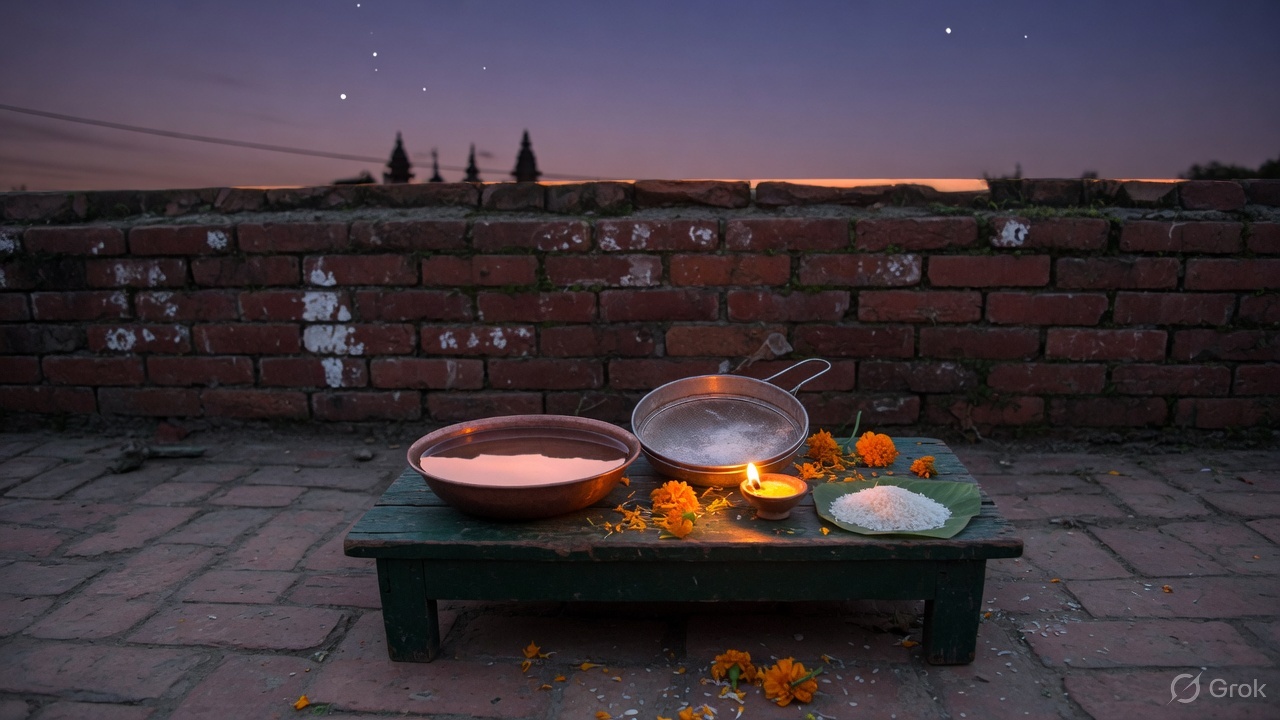 Ahoi Ashtami in Nepal 2026 — before Tihar, on Kathmandu's own skyAhoi Ashtami 2026 is Sunday 1 November, before Nepal's Tihar. Nepal's clock is fifteen minutes ahead of India; Kathmandu's stars are not a Lucknow screenshot plus a quarter of an hour.Read the article
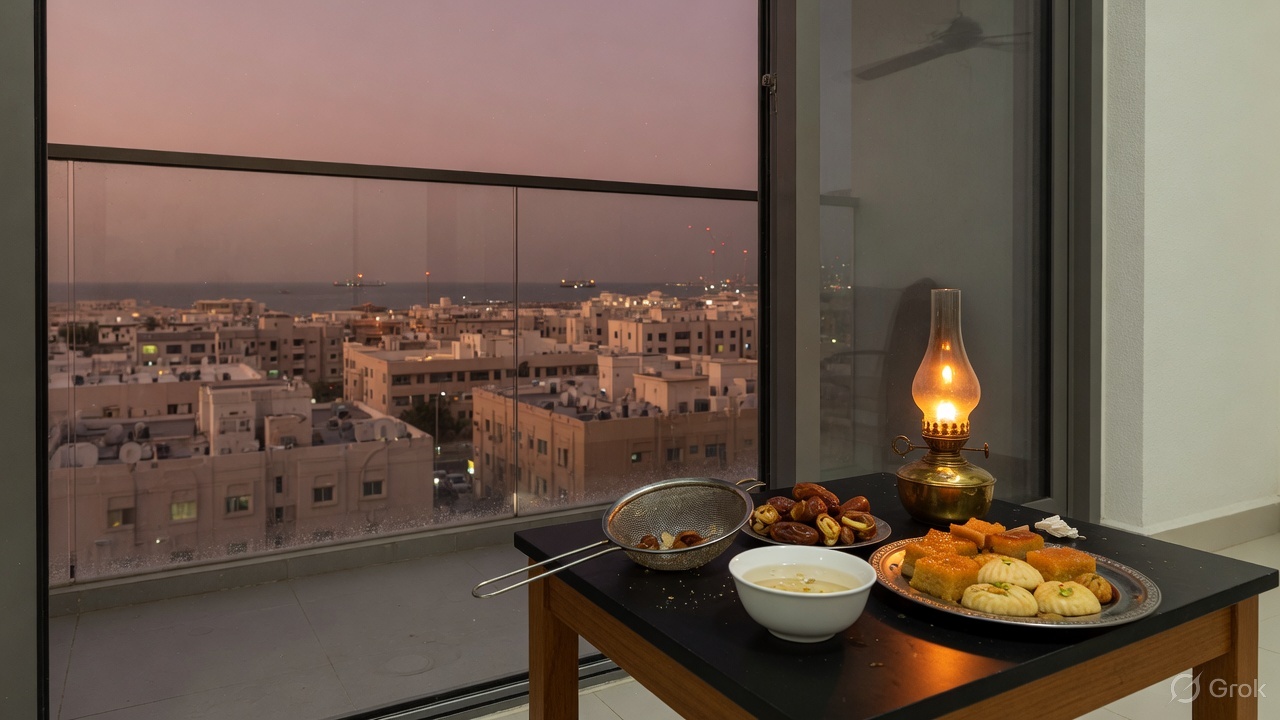 Ahoi Ashtami in the UAE 2026 — a working Sunday, and a sky that is not Dubai-onlyAhoi Ashtami 2026 is Sunday 1 November, a working day across the UAE. Gulf Standard Time is not Indian time minus ninety minutes, and Abu Dhabi's stars are not a Dubai screenshot.Read the article
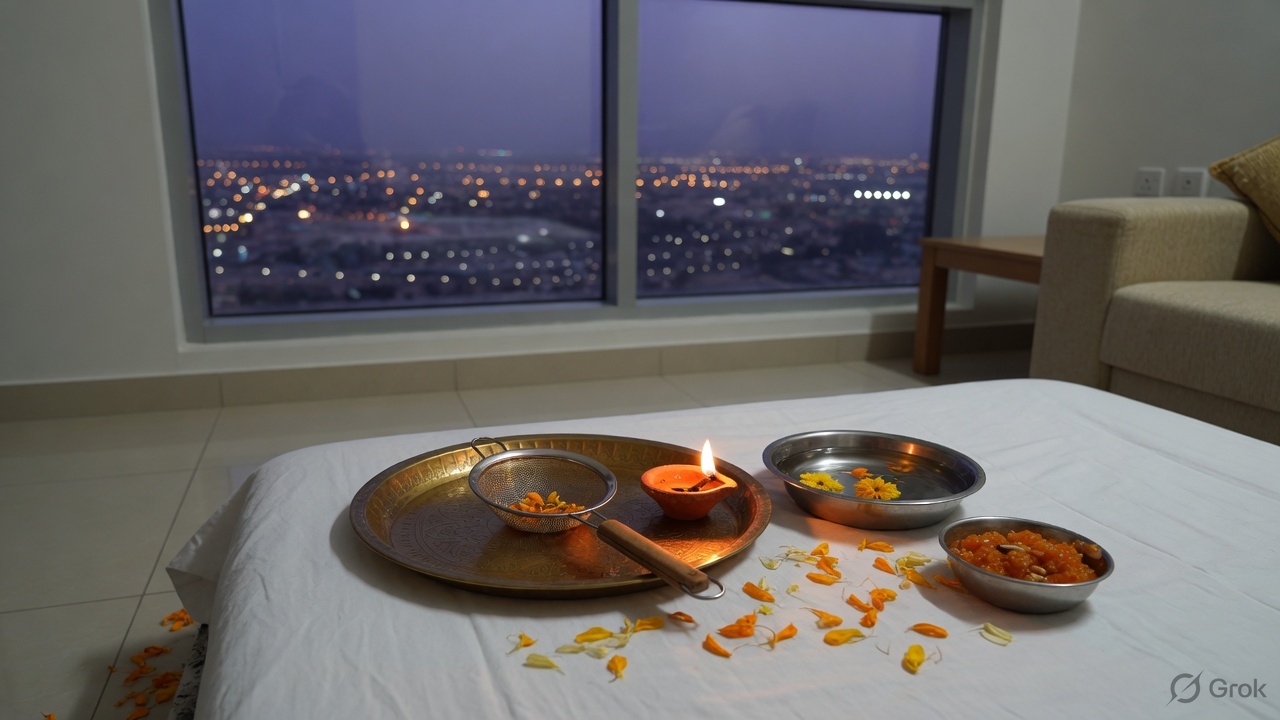 Ahoi Ashtami in a Dubai flat 2026 — the sieve, the window, a working SundayAhoi Ashtami 2026 in Dubai is Sunday 1 November, a school day. The fast breaks at stars seen from that window, not at a Lucknow moon, and the thali has to live with the smoke detector.Read the article