
Vivah muhurat — how the hour is taken after the match is chosen
Published: 31 October 2026 · Acharya Krishna Kant Shrimukh Shandilya Ji Maharaj · 9 min read
A vivah muhurat is the hour of the ceremony, read after the two people are already the match the family will conduct. People arrive with a hall receipt, a website’s list of wedding days, or a cousin’s date copied because the flowers matched. They have been told that a printed ‘shubh muhurat’ is enough for both charts, that Bhadra has cancelled the month, and that a beautiful lagna will repair a low count of guna. I am writing this on 31 October 2026, from Sultanpur. A list is not a lagna. The hall is a room you have paid for. The muhurat is a day and a rising sign in the city where the mandap will stand, checked against both births. This page starts when that match is the one you will do. How a delay sits in one chart, and how a low guna count is read, are separate articles on this site. I will not repeat them here in order to frighten a booking.
If you want the hour taken, write on WhatsApp both birth dates, both birth times, and both birthplaces, and say whether each time is exact or remembered. Add the city of the mandap and the real range of dates: leave, hall, and the season you can actually gather the house. I am in Sultanpur. There is no fee on this page. I will not promise a happy marriage, a child, or that the hour will cancel a dosh.
Where the work starts
Matching asks whether these two charts can keep a house. The muhurat asks when, inside your real calendar, the pheras can be done without insulting either chart or the sky of that city. If you have not decided the person, you do not yet have a muhurat question. You have a matching question. Send me a stack of five proposals and ask for one lucky Sunday, and I will send the stack back. One couple. Both times. One city of the fire.
Engagement, a registry signature, and the pheras are three acts. Families collapse them because the caterer needs a single date. The civil registration is a legal act and it keeps the slot the court gives. I will not pretend a court counter is a lagna, and I will not tell you to skip the law because a tithi looked heavy. If you want a muhurat, tell me which act it is for. In this house I take the hour of the pheras unless you name another act, and I will say which act I used so nobody later claims I blessed the reception.
Day, then lagna, then the two charts
First the day, inside the range you can keep. I look at tithi, weekday, and nakshatra together. Amavasya is left. Many houses also leave ashtami and chaturdashi, and they prefer the bright fortnight. I will not make the bright fortnight a national rule on this page, because a clean lagna in the dark fortnight is sometimes the only honest hour inside a short leave. When I see your range I will say what I am leaving and why. A Sunday is not chosen because guests do not work on Sunday. In a Gulf city Sunday is a working day. The mandap’s city decides the week, not the guest list.
The nakshatra of the day is checked against both janma nakshatras. A day that is the bride’s birth nakshatra, or the groom’s, is looked at twice and usually left. It is not worshipped because the hall has taken an advance. The same care applies to the tithi of birth when the family keeps that custom. I ask before I assume. A family that has never observed janma tithi does not need me to invent a panic around it in the last week.
Then the lagna of the city at the hour of the pheras. This is the part a season poster cannot print, because the poster does not know your mandap. I want a lagna that can hold a marriage: the seventh house of that muhurta chart not treated as a dumping ground, the lagna lord able to act, Venus not ignored because the decorator preferred sunset for the photographs. Rahu kalam is not a phera hour. A pretty lagna inside Rahu kalam is moved earlier or later. ‘Close enough’ is how a careful day becomes a careless step.
Last, the two charts, which is where a borrowed muhurat fails. An hour that is easy for the groom can be the bride’s eighth-lord day, or the reverse. I will not certify a date from one person’s screenshot. Both times matter. A remembered time, ‘around dawn’, is usable only if I tell you the hour is soft and the lagna may flip. I will not sharpen a soft time to make the hall look chosen by the stars.
What families have already been frightened by
Bhadra is a portion of certain tithis, not a month with a lock on it. Many houses avoid the Bhadra portion for the pheras. They do not cancel every dawn in that fortnight. If your only free day clips Bhadra, send the hours, not a decision already made in panic. Panchak is a short lunar run. Some houses will not begin a wedding inside it. Some restrict other acts and still marry. I will look at your dates before a headline empties them.
Guru asta and Shukra asta are real pauses in many north Indian houses. When those planets are combust, weddings are often not begun. I will not print this year’s combustion dates on a page that will be forwarded after they have ended. If the months you name fall in either asta, I will say so from the ephemeris when I read the range. Do not ‘adjust’ a combust week by moving the pheras to 4 a.m. so the calendar date looks different. The sky does not honour the caterer’s midnight.
Mangal, a low guna count, and a late dasha are not repaired by a jasmine mandap. Shanti, where a chart needs a settling rite, is a different sitting and it does not delete the factor. A separate article on this site is the low count. Another is what a delay actually is. Read those if that is your question. If your question is the hour of a match you have already accepted, stay on this page and do not ask the lagna to do the matching over again.
The city of the fire
The lagna is cast for the ground where the couple will take the pheras. A Delhi boy and a Jaipur girl marrying in a Lucknow hall need Lucknow’s clock, not an average of the two birth cities. Birth cities belong to the charts. The mandap city belongs to the hour. Name it plainly. A farmhouse on the edge of the metro is not automatically the airport’s latitude. If you know the locality, send it.
A wedding held in Dubai, Abu Dhabi, or another Gulf city uses that city’s sun. I will not subtract ninety minutes from a Sultanpur muhurat and call it done. Nepal’s mandap is Nepal’s sky, further east than an Indian time plus fifteen minutes. If the pheras are in Kathmandu and the families live in the Tarai, say both, and do not assume one Wednesday covers them. I do not keep a house in any of those cities. The three forms stay what they are. I travel when the date is fixed and the house has asked. The sitting is in India if you come. The hour itself can be named live.
If the hall is already paid, say that date on WhatsApp and send both charts with it. I will tell you whether that evening can hold a lagna or whether you are only decorating a booked room. Changing a hall hurts. Pretending a bad hour is clean hurts longer. Dakshina is spoken before I do that reading. There is no online payment and no package that includes the decorator.
What you do not need to send
You do not need the menu, the card design, or a photograph of the clothes. You do not need a demand that the wedding fall before someone’s visa appointment. I will not move a lagna to chase a stamp, and I will not write a letter that claims the stars require a particular embassy date. Bring the two times, the mandap, and the range. If a parent insists on a weekday because their own wedding was on that weekday, tell me, and I will see whether that weekday exists inside a clean stretch. Affection for a memory is not a limb of the panchang. It can still be honoured when the sky allows.
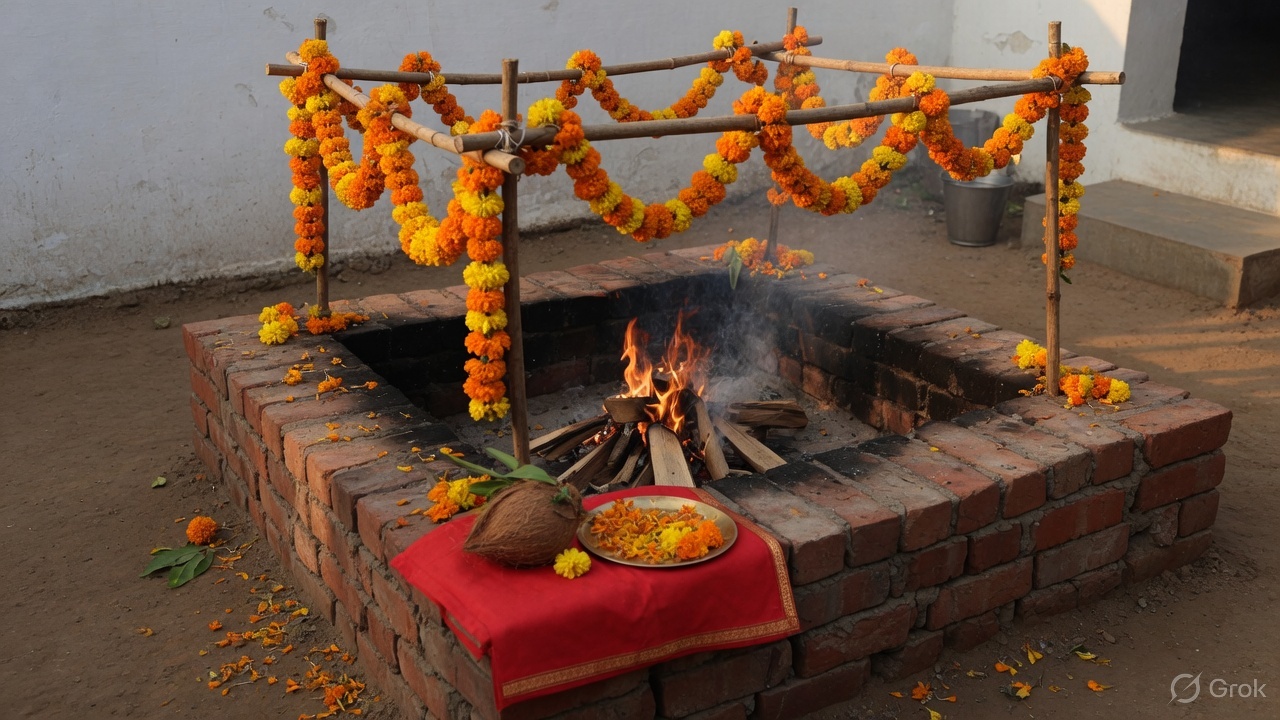
A small home ceremony and a large hall use the same sky. The fire is the fire. I will not lengthen the muhurat because more guests are invited, and I will not cheapen a courtyard wedding because no one hired a gate. The hour of the pheras is short. The reception can sit outside it. Do not drag the seven steps across Rahu kalam in order to keep the photographer’s sequence. Finish the rite inside the hour you were given. Feed the guests after.
Questions people ask
The hall is booked. Is that the muhurat?
It is a constraint. Send the date, the city, and both births. I will say whether that evening can hold the pheras.
Can one printed list serve both families?
No. A list does not know either birth time or the mandap’s lagna. Both charts are read against the hour.
Will a good muhurat fix a low guna count?
No. Matching is a different reading. The hour does not delete a count, a Mangal factor, or a delay in the dasha.
Do you promise a happy marriage?
No. I name an hour that the panchang and the two charts can bear. The marriage is what the two people then keep.
If the match is chosen and the hour is not
This page is how a vivah muhurat is taken, once the two people are the match you will conduct. I am Acharya Krishna Kant. The sittings of this site are close to twenty years of work from Sultanpur. Send both births, the mandap’s city, and the real range on WhatsApp. I will not add a phal to the pheras.
Share the service and a preferred date. You will get a WhatsApp message to confirm. No account needed.
Book ConsultationRelated
Read next
 Griha pravesh muhurat — the possession date is not the hourA griha pravesh muhurat is read for the city of the door, inside dates the family can truly be there. The builder’s possession slip is not that hour.Read the article
 Govardhan Puja 2026 — Tuesday 10 November, Annakut, not a second DiwaliGovardhan Puja 2026 is Tuesday 10 November, the day after the Diwali night of Sunday 8 November. Annakut is a mountain of food offered in the day, not Lakshmi’s evening repeated.Read the article
 Bhai Dooj 2026 — Wednesday 11 November, the tilak is not Diwali’s eveningBhai Dooj 2026 is Wednesday 11 November. The tilak is a morning rite after sunrise, not Lakshmi Puja repeated, and not Govardhan’s Annakut moved by a day.Read the article